Have you ever opened a Bible and wondered why the same verse sounds different in another Bible? You may read a familiar passage in the King James Version, NIV, ESV, or another translation and then see NASB beside a verse. That small group of letters can raise a simple question: What does NASB mean?
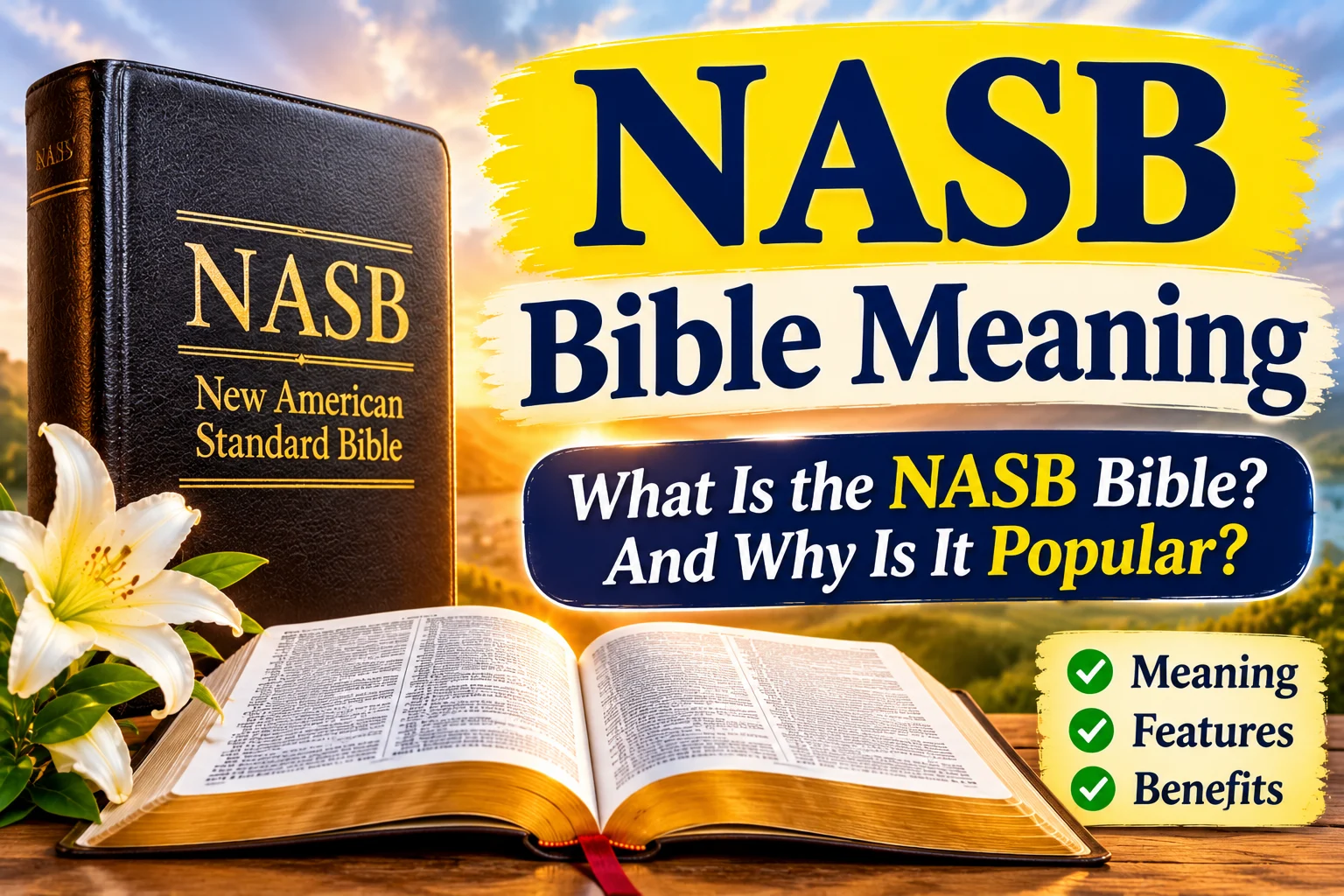
The NASB Bible meaning is New American Standard Bible. It is an English translation of the Bible known for its close attention to the Hebrew, Aramaic, and Greek biblical texts. The NASB follows a formal equivalence approach. This means it seeks to stay close to the wording and structure of the original languages while keeping the English understandable.
For Christians, the NASB can be more than a Bible translation. It can be a helpful tool for Bible study, prayer, teaching, and personal faith. Understanding what NASB means can help you know why its wording may sound different from other Bible versions and how you can use it in your daily walk with God.
Biblical Meaning of NASB
What Does NASB Stand For?
NASB stands for New American Standard Bible. It is an English translation of Scripture, not a separate book of the Bible and not a new set of biblical teachings.
The NASB project began in 1959 under the direction of The Lockman Foundation. The complete NASB was first published in 1971. The translation grew from a desire to preserve the strengths of the American Standard Version while using newer biblical scholarship and more current English.
The NASB has been updated several times. Major updates came in 1977, 1995, and 2020. The purpose of these updates was to improve accuracy, clarity, and readability while keeping the translation’s formal-equivalence approach.
What Makes the NASB Different?
The main idea behind the NASB is precision.
The translators sought to represent the original biblical languages as closely as possible in English. The Old Testament draws on Hebrew and Aramaic sources, while the New Testament is translated from Greek textual sources.
This approach is sometimes described as word-for-word translation. However, it does not mean that every Hebrew or Greek word can always be replaced by one English word. Languages do not work that simply. Grammar, sentence structure, idioms, and context all matter.
The goal is to communicate the meaning of the original text with as little unnecessary interpretation as possible.
What Does NASB Mean for Christian Bible Study?
For many Christians, the value of the NASB is its focus on careful study. Its wording can help readers slow down and look closely at what a biblical passage actually says.
For example, when studying a passage about faith, a reader might compare the NASB with another translation. Differences in wording can encourage the reader to examine the context, study cross-references, and look at the original-language background.
The Bible itself reminds believers of the importance of careful attention to God’s Word. 2 Timothy 2:15 speaks about accurately handling the word of truth. Psalm 119:105 describes God’s word as a lamp for one’s path.
These verses are not statements about the NASB specifically. They point to a broader Christian principle: Scripture should be read carefully, understood in context, and lived out with faith.
The spiritual value of a Bible translation is therefore not found in the acronym itself. NASB is a translation tool that can help a Christian engage with Scripture.
Spiritual Significance and Symbolism of the NASB
The NASB does not have a hidden biblical symbolism. Its name simply identifies the translation: New American Standard Bible.
Still, the translation can have an important place in a Christian’s spiritual life.
Imagine someone beginning each morning with a Bible, a cup of coffee, and a few quiet minutes. They read a passage in the NASB and pause over one sentence. That verse may encourage them during a hard day. Another person may use the NASB while preparing a Bible lesson. Someone else may read it during evening prayer.
In these moments, the important thing is not the letters NASB. The focus is on God’s Word and the message of Scripture.
A careful Bible translation can support several parts of spiritual growth:
- Faith: Scripture reminds believers of God’s character and promises.
- Wisdom: Biblical teaching can guide choices and attitudes.
- Hope: God’s Word can bring comfort during difficult seasons.
- Prayer: Scripture can give believers words and ideas for prayer.
- Transformation: Reading Scripture can challenge believers to grow in how they live.
Romans 12:2 speaks about being transformed through the renewing of the mind. James 1:22 encourages believers not merely to hear God’s Word but to put it into practice.
This gives Bible reading a deeper purpose. The goal is not simply to know which translation sounds most precise. The goal is to know God, understand His Word, and live faithfully.
The NASB can be one useful part of that journey.
NASB 1995 vs. NASB 2020
One important part of understanding the NASB Bible meaning is knowing that there is more than one modern NASB edition.
The NASB 1995 is widely known for its traditional and more literary style. It updated the 1977 NASB while keeping its strong commitment to formal equivalence. Many pastors, teachers, students, and readers have used it for Bible study, teaching, preaching, and personal devotion.
The NASB 2020 builds on the NASB 1995. It updates vocabulary, grammar, and sentence structure to make the text clearer for modern English readers. The 2020 update was designed to improve accuracy, modernize language, and increase readability while maintaining the established translation approach.
One noticeable goal of the 2020 edition is gender accuracy. The translation sometimes uses modern wording where older English expressions could be misunderstood. These changes aim to communicate the meaning of the original languages more clearly to today’s readers.
So, if you see NASB 1995 and NASB 2020, you are not looking at two unrelated Bibles. The 2020 edition is an update of the earlier NASB tradition.
Biblical Interpretations and Real-Life Use
How does the NASB fit into real Christian life?
Consider someone who is worried about the future. They may read Philippians 4:6–7 and reflect on prayer, anxiety, and God’s peace. Another believer may read Proverbs while seeking wisdom for an important decision. Someone facing grief may turn to the Psalms for comfort.
The NASB can be used in all these situations.
It is also useful for Bible comparison. Reading the same passage in two or three translations can reveal differences in wording. This does not automatically mean that one translation is right and another is wrong. Often, the differences come from the challenge of expressing ancient Hebrew and Greek ideas in modern English.
For deeper study, readers can also use study Bibles, commentaries, cross-references, and original-language tools.
The most important habit is to read Scripture in context. Do not build a spiritual message from one isolated sentence. Read the verses around it. Consider who is speaking, who is being addressed, and what the larger passage teaches.
Prayer can also help make Bible reading personal without turning every verse into a private prediction or hidden message.
Practical Lessons & Faith Insights
The NASB can be a valuable tool for Christians who want to study Scripture carefully.
Use it slowly. Read the passage, understand its context, pray over what you learn, and apply its teaching. Compare translations when a verse is difficult. Most of all, remember that a translation is a window through which you read Scripture, not the focus of your faith.
Let Bible study lead you toward faith, obedience, wisdom, hope, and a deeper relationship with God.
FAQs About NASB Bible Meaning
1. What Does NASB Mean in the Bible?
NASB means New American Standard Bible. It is an English translation of the Bible known for its formal-equivalence approach and close attention to the original biblical languages.
2. Is NASB a Good Bible Translation for Study?
The NASB is widely used for careful Bible study and is known for its emphasis on accuracy and formal equivalence. The best translation for a reader can depend on their needs, reading style, and study goals.
3. What Is the Difference Between NASB 1995 and NASB 2020?
The NASB 2020 is an update of the NASB 1995. It modernizes language and seeks to improve clarity and readability while maintaining the NASB’s formal-equivalence approach. The NASB 1995 retains a more traditional style of English.
4. Is NASB a Literal Translation?
The NASB is commonly described as a formal-equivalence or word-for-word translation. Its goal is to stay close to the wording, grammar, and structure of the original Hebrew, Aramaic, and Greek while still producing understandable English.
5. What Does NASB Mean Spiritually?
NASB itself has no special hidden spiritual meaning. It is simply the name of an English Bible translation. Spiritually, Christians may use the NASB to read Scripture, pray, grow in faith, and seek God’s guidance.
Conclusion
The NASB Bible meaning is simple: NASB stands for New American Standard Bible, an English translation created with a strong focus on accuracy and formal equivalence. It has been updated over the years, with the NASB 2020 bringing more modern English while maintaining the translation’s core approach.
For Christians, the deeper value is not in the letters NASB but in the Scripture they help us read. Use the Bible with prayer, humility, and care. Read it in context, reflect on its truth, and allow God’s Word to shape your daily life.
May your time in Scripture lead you toward greater faith, deeper hope, and a closer walk with God.
Circumcised Bible Meaning: What It Symbolizes in Scripture and Your Faith Journey

I am a professional content writer with a passion for the Bible, Christian faith, prayer, and spiritual growth. I specialize in creating well-researched, insightful, and reader-friendly articles on biblical teachings, Bible verses, prayer, faith, and Christian living. My goal is to make biblical topics easy to understand while providing meaningful and encouraging content that helps readers grow in their faith and strengthen their relationship with God.